2013年5月26日日曜日

Dining Dojo Drinks: The Ginger Russian Donkey

Recently, I have been having a taste for Moscow Mules.  I was trying to create a new recipe while still be inspired by the classic recipes.  There are two recipes for the Moscow Mule.  Here is the history behind the classic Moscow mule of vodka, lime juice, and ginger beer.
The cocktail was invented in 1941 by John G. Martin of G.F. Heublein Brothers, Inc., an East Coast spirits and food distributor, and "Jack" Morgan, President of Cock 'n' Bull Products (which produced ginger beer) and proprietor of the Cock 'n' Bull restaurant on Sunset Boulevard in Los Angeles popular with celebrities.[1][2][3] George Sinclair (2007) quotes from an article run in the New York Herald Tribune:
The mule was born in Manhattan but "stalled" on the West Coast for the duration. The birthplace of "Little Moscow" was in New York's Chatham Hotel. That was back in 1941 when the first carload of Jack Morgan's Cock 'n' Bull ginger beer was railing over the plains to give New Yorkers a happy surprise... Three friends were in the Chatham bar, one John A. Morgan, known as Jack, president of Cock 'n' Bull Products and owner of the Hollywood Cock 'n' Bull Restaurant; one was John G. Martin, president of G.F. Heublein Brothers Inc. of Hartford, Conn., and the third was Rudolph Kunett, president of the Pierre Smirnoff, Heublein's vodka division. As Jack Morgan tells it, "We three were quaffing a slug, nibbling an hors d'oeuvre and shoving toward inventive genius". Martin and Kunett had their minds on their vodka and wondered what would happen if a two-ounce shot joined with Morgan's ginger beer and the squeeze of a lime. Ice was ordered, limes procured, mugs ushered in and the concoction put together. Cups were raised, the men counted five and down went the first taste. It was good. It lifted the spirit to adventure. Four or five later the mixture was christened the Moscow Mule...
As suggested above and evidenced by an article run in Insider Hollywood the Moscow Mule was most popular in Los Angeles: "There is a new drink that is a craze in the movie colony now. It is called 'Moscow Mule.'" (Gwynn, 27 December 1942).
The Nevada State Journal reinforced the Mule's popularity in reporting: "Already the Mule is climbing up into the exclusive handful of most-popular mixed drinks" (12 October 1943).
In 2012, a Moscow Mule kit that included Cock 'n Bull Ginger Beer was included as part of Oprah Winfrey's Favorite Things list.
Besides the classic Moscow mule, many bars are making the Moscow mule by substituting the ginger beer with ginger ale.

        After discovering the two different recipes, I decided to make to both versions of the Moscow mule.  With the classic Moscow mule, I decided to use the Fentimans Ginger Beer.  For the hybrid version of the drink, I chose to use Canada Dry Ginger Ale.  When tasting both of the drinks, there is difference in taste of the cocktail.  The ginger beer provided a spicy ginger kick to the drink, while, the ginger ale provided sweetness and effervescence to the drink.  Both versions are tasty.  It all depends on whether if you like sweetness or a spicy ginger kick to your drink.

        This is where the idea of the Ginger Russian Donkey cocktail came to mind.  I wanted the cocktail to have the sweetness and a ginger kick.  For the sweetness, I decided to use the N.E.O. Professional Ginger Syrup (a Japanese product), Fentiman's Ginger Beer, vodka, and lime juice.  The ginger syrup provides a sweet ginger kick to the drink that balances out the ginger beer.  The addition of lime juice to the cocktail provides a hint of sour citrus that cuts through the ginger and sweetness of the syrup rather nicely.

Here is the recipe of the Ginger Russian Donkey!! 
 Put ice in a cocktail glass.
150 ml of vodka
50 ml of lime juice
25 ml of ginger syrup
Top with ginger beer
Garnish with a lime wedge


2013年5月13日月曜日

Dining Dojo Drinks: Toyama Black Cider

     Recently, I went to Toyama Prefecture, Japan, during Golden Week for a short vacation.  My wife and I took a bus trip to the Tateyama Kurobe Alpine Route.  During one of the scheduled breaks that we had, we went to a convenient store to pick up lunch and something to drink.  When I was in the store, I noticed this drink called Toyama Black Cider.  Toyama is famous for black ramen that is made with black soy sauce. 

      You maybe saying to yourself that soy sauce is already black, which is true.  However, black soy sauce (黒醤油) is darker in color and heavier in taste.  If you would taste regular soy sauce and black soy sauce, you would be able to tell the difference between both of them right away.

     Also for those of you who are unfamiliar with Japanese soft drinks, cider is a popular soft drink that is more akin to Sprite or 7UP without the lemon lime taste.  There is no alcohol in the drink what so ever. Most ciders that you buy are clear not black.  Why is this called black cider though?

      As I noted earlier that Toyama is famous for black ramen.  The black cider is marketed as a drink to go with the black ramen.  The black cider is flavored with soy sauce and sesame. 

      When smelling the drink, you will notice the soy sauce right away.  Its a pretty interesting smelling drink to say the least.  The taste of the cider is also unique.  At the front of the mouth, you will get a lot of carbonation just like with any soft drink. In the middle of the mouth, the soy sauce flavors become more prominent in the drink but nothing overbearing.  You can taste the soy sauce without any of the salt that is associated with it.  At the back of mouth, you will find the roundness of sesame seeds and soy sauces mingle with each other.  It is somewhat surprising for the first drinking it.

      Overall, would I buy this drink again, yes but only if I could find it where I live.  This drink is mostly sold in Toyama.  If you are living in or visiting Toyama. do yourself a favor and try a unique Japanese beverage.  You will not be disappointed.

Here is the link to my video review.
http://www.youtube.com/watch?v=05UcrY_vJx8

For more information on the Toyama black cider, visit
http://www.tombow-b.jp/toyamablackcider/
(this site is in Japanese)

2013年5月12日日曜日

Chicago Tangent: Chicago is rated one of the best food cities in the USA

Recently, I read a great article on the Huffington Post talking about how Chicago is now ranked one of the best food cities in America.  Here is the article for those who did not get a chance to read it.

Chicago Best Food City: Munchies People's Choice Awards Says Windy City Is Tops For Tasty Eats

Posted:   |  Updated: 05/09/2013 5:51 pm EDT
According to the latest Munchies Awards announced on Wednesday, Chicago is a food city that's second to none.
Foodie website The Braiser dubbed the prizes the "backyard version of the James Beard Awards," and noted the Munchies: The People’s Choice Awards skewed heavily toward the Midwest when it came to winners of the nation's best chef, food magazine, website and cuisine-specific eats.
The somewhat new Bar Toma won the hearts (or tastebuds) of Muchies voters for best pizza, while Lincoln Park's The Butcher and the Burger came out on top for its patty perfection.
(Read chefs' thoughts on the city's culinary scene and their favorite Chicago food spots below.)

Not only did Chicago beat out New York City, Los Angeles, San Francisco and Portland for the distinction of America's "Best Food City," the Hog Butcher of the World made a strong showing across several cuisine-specific areas, too.
Chicago chef Paul Kahan (who recently notched a major James Beard nod) ranked among the finalists for Best Chef, while Big Star, Black Dog Gelato and Intelligentsia were in the running for best tacos, ice cream and coffee, respectively.
Nominees were chosen by panelists (which included highly opinionated Chicago food powerhouse Graham Elliot) and set to a public vote.
Recently, the city's iconic Super Dawg received the honor of America's Most Life-Changing Hot Dog, (pictured above) and Chicago nabbed another nod from Esquire for our indisputably awesome pizza.
Though the local food scene has had no shortage of accolades from industry kingmakers like the James Beard Foundation and the Michelin Guides, the Munchies show it's always nice to get love from the voting (and eating) public.
This is great news for me.  Even though, I am now living in Japan.  I am originally from Chicago.  I still love Chicago.  I remember going to some great restaurants and bars with friends and family.

    When talking about food and which city has a bigger food scene, people would argue that New York City has the one of the most vibrant food scenes in America.  I would not know this personally because I have never been to New York City myself.  Food critics and other people in the food industry would sometimes pass up Chicago in order to go places like Miami, New Orleans, or Los Angeles.  However, people who live in Chicago know that we have a great food scene and hear that now Chicago is one of the best ranked food cities around really pleases me.

     Eventually for me, I will be returning back to Chicago to live, and I cannot wait to try all of the food that I have been missing over the years.  For a better understanding of what I am talking about and why I am so proud of my hometown, just watch these videos.  You will see that Chicago is known for not only bad weather, Al Capone, and the Chicago Bulls but also for great food.


2013年4月30日火曜日

Dining Dojo Editorial: Why is Golden Week so Golden?

Beginning last week Friday, Golden Week started in Japan.  For those readers who are not living in Japan, you probably have no idea what I am talking about.  Golden Week in Japan starts on April 29th, Showa Day (昭和の日) and ends on May 5th, Children's Day, Kodomo no Hi (こどもの日).  Golden Week, Ougon Shukan (黄金週間) comes originally from Oogata Renkyuu (大型連休), long consecutive holidays. 

During Golden Week, there are four public holidays and three regular days.  Most companies are closed on April 30th, May 1st, and May 2nd.  So, many people have about a full week of paid holidays.  Also, Golden Week may be extended if there are weekends.  Note that May Day is not a public holiday.  However on May Day, you can watch many demonstrations and protests in the streets and parks. 

Traveling during Golden Week is very common.  Be forewarned: if you do not large crowds of people, do not travel during Golden Week.  Many tourist places become very crowded during Golden Week.  The train stations and airports are constantly full of travelers.  Many Japanese travelers go overseas during Golden Week for vacation. 

You may be asking yourself, why is this week of long consecutive holidays called "Golden Week"?  According to Wikipedia:
The National Holiday Laws, promulgated in July 1948, declared nine official holidays. Since many were concentrated in a week spanning the end of April to early May, many leisure-based industries experienced spikes in their revenues. The film industry was no exception. In 1951, the film Jiyū Gakkō recorded higher ticket sales during this holiday-filled week than any other time in the year (including New Year's and Obon). This prompted the managing director of Daiei Film Co., Ltd. to dub the week "Golden Week" based on the Japanese radio lingo “golden time,” which denotes the period with the highest listener ratings.[4]
  ゴールデンウィーク」の名称は、映画会社の大映が松竹と競作して1951年(昭和26年)に同時上映となった獅子文六原作の『自由学校』が大映創設以来(当時)最高の売上を記録[3]し、正月映画やお盆映画以上の興行成績を残したことで[4]、映画界でこの時期に多数の動員を生み出すことや活性化を目的として当時の大映常務取締役であった松山英夫によって作成された宣伝用語であり[4][5]、1952年(昭和27年) - 1953年(昭和28年)頃から一般にも使用されるようになり[5]、他の業界にも広まった。なお、このときの大映は続いて秋の文化の日を中心とした期間を「シルバーウィーク」と名付けたが、当時こちらは定着しなかった[4][5
If you are going to see a movie during this time of the year, just remember that this was the action that started the term "Golden Week".
 Also, it is interesting to note that Golden Week is not a Japanese celebration.  Golden Week is also celebrated in China. Once again from Wikipedia:

Golden Week (黄金周) in the mainland of the People's Republic of China is the name given to a semi-annual 7-day national holiday, implemented in 2000:[1]
  • The "Chinese Lunar New Year Golden Week" begins in January or February.
  • The "National Day Golden Week" begins around October 1.
A third Golden Week holiday, which spanned May 1 and celebrated Labour Day, existed until 2007.
Three days of paid holiday are given, and the surrounding weekends are re-arranged so that workers in Chinese companies always have seven continuous days of holiday. These national holidays were first started by the government for the PRC's National Day in 1999 and are primarily intended to help expand the domestic tourism market and improve the national standard of living, as well as allowing people to make long-distance family visits. The Golden Weeks are consequently periods of greatly heightened travel activity.
 Have fun during Golden Week!!
 

2013年4月29日月曜日

Dining Dojo Kyushoku: A Mixture of Chinese, Western, and Japanese Dishes

Here are more Japanese school lunches that I ate last week.  For school lunches, Japanese children are given an opportunity to try many different dishes that can range from Chinese to Western to Japanese.  Itadakimasu!!

Penne pasta in a tomato sauce, cucumber and daikon (white radish), bread, quiche, and milk

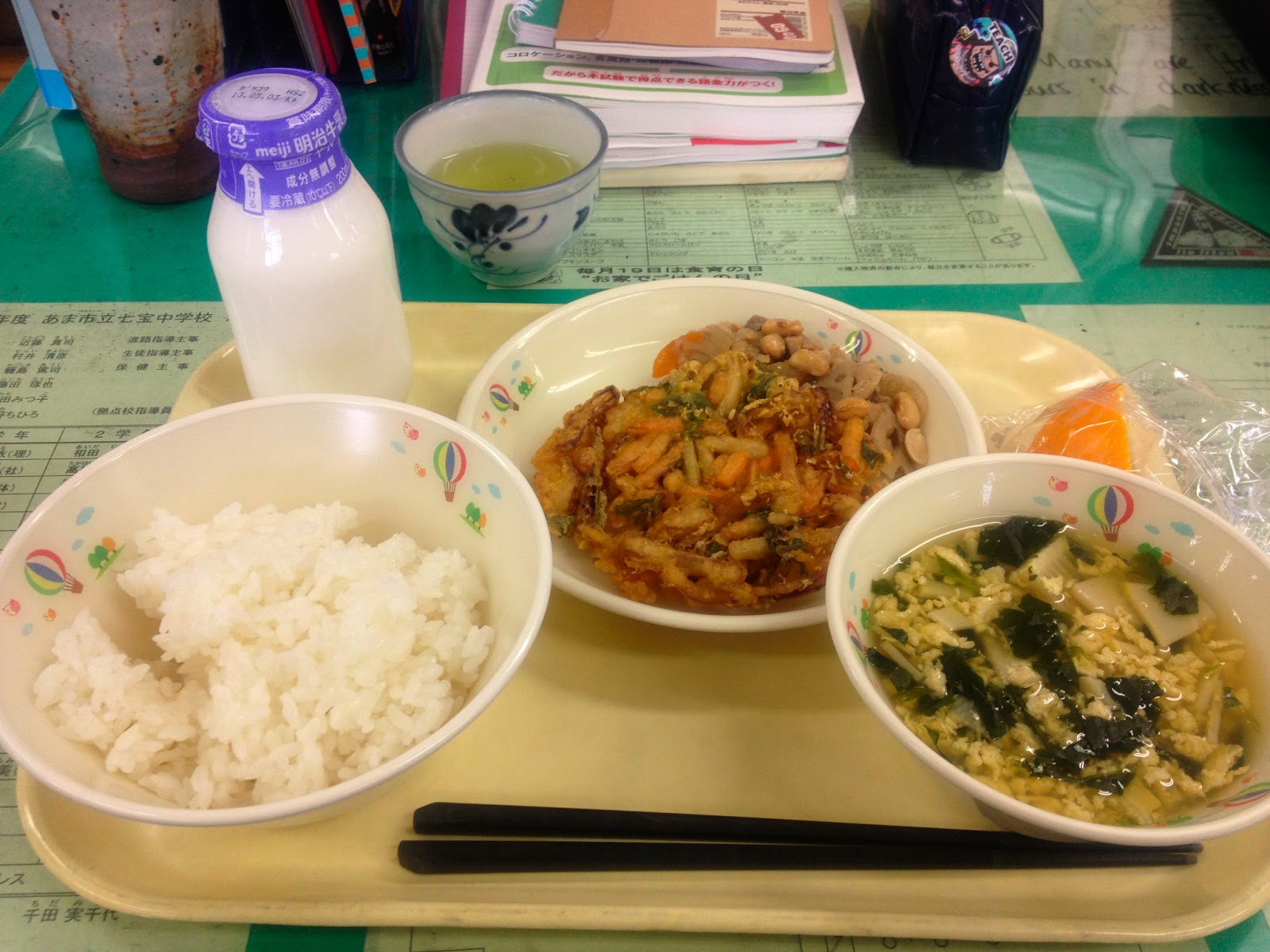
 Rice, mixed vegetable tempura, stewed beans, egg drop soup with seaweed and tofu skin, milk, and a navel orange

 Rice, chop suey, grilled gyoza (potstickers), bean sprout salad, and milk

 Rice, grilled salted salmon (鮭の塩焼き), komatsu (Japanese potherb mustard leaf) and white radish with a sesame dressing, and stir-fried seaweed, pork and vegetables (ひじきの炒め煮)

Gochisosamadesita!!

Superfood for your Brain: Berries

I love blueberries!!  I put them in my smoothies, yogurt, and cereal in the morning.  Blueberries are extremely healthy for you.  They can help improve your vision, and now, they can help your brain.  Blueberries are a super food that people should start including in their diet if they have not already. 

Here is a great article from Huffington Post Food section.

Berries Benefit Brain By Clearing Toxic Protein Accumulation, Animal Study Finds

Posted:
Berries could play an important role in clearing the accumulation of toxic proteins in the brain, according to a new study in mice.
The research, presented at the Experimental Biology 2013 meeting, showed that the brains of rats that consumed berries for two months were better protected against radiation, which is meant to induce accelerated aging in the mice.
Specifically, researchers found that the berry consumption was linked with increased autophagy, which is the natural process the brain undergoes to clear out accumulation of toxic proteins. They noted that phytonutrients -- plant chemicals -- in berries may be responsible for this effect; berries are known to be high in anthocyanins.
Researchers said that the findings could be especially meaningful if they also apply to humans, since diseases like Parkinson's and Alzheimer's disease involve accumulation of toxic proteins. The next step is a study, currently being conducted, on humans ages 60 to 75 to see if berries' have the same sort of effect.
Even though the findings have yet to be published in a peer-reviewed journal -- and thus should be considered preliminary -- a past study from Harvard researchers showed that eating berries regularly could help slow cognitive decline in older people, HuffPost's Catherine Pearson reported.
Berries Benefit Brain By Clearing Toxic Protein Accumulation, Animal Study Finds
Posted:

2013年4月24日水曜日

Dining Dojo Kyushoku: From April 8th to the 19th

At my job, I have an opportunity to try Japanese school lunch (kyuushoku 給食) at the junior high school where I teach at.  The school lunches are not made at on the school premises.  Instead, the school lunches are made at local school lunch centers that are located near the school.  One school lunch center is responsible for providing school lunch to the local elementary schools and junior high schools located in the neighborhood.

It should be noted that in Japan, high school students do not eat kyuushoku.  The students bring lunch boxes from their house or they can order a lunch from a shop that specializes in making lunch boxes.  High school education in Japan in not compulsory.

These are lunches in which I ate at the junior high school where I work at.  I am not going to disclose where I work at because schools and boards of educations take school lunch very seriously.  Each school has a person that is responsible for the dietary needs of the students.  With the school lunch centers and other dieticians, they are responsible for making the school lunch menu everyday for which school lunch will be provided to the students.

Here are the pics of the school lunch that was given to me.  Itadakimasu!!
Rice, sukiyaki, chikuwa (rolled fish cake) tempura, pickled vegetable, milk, and a strawberry crepe for dessert.

Sekihan (Adzuki (red bean) rice flavored with sesame seeds and salt, deep-fried squid, stir fried burdock root (gobo in Japanese), seaweed and tofu skin (yuba) soup, and milk

 Rice, lotus root salad, pork red miso soup (tonjiru 豚汁), fried pork (yakiniku 焼き肉), and milk

 Pork steamed buns, cucumber salad, Chinese soup with noodles (chuukamen 中華麺), and milk.

Rice, spinach and bean sprout with a vinegar dressing, nikujaga (stewed pork, potatoes, carrots, green peas), steamed mackerel in miso wrapped in foil, and milk

Hamburger with bun, corn and cucumber salad, alphabet noodle soup, and milk
Strawberry yogurt, curry and rice, bread pork cutlet, pickled vegetables (a typical dish that accompanies Japanese curry and rice), and milk
Mapo tofu (tofu with ground pork in a spicy sauce), rice, pork steam buns, cucumber salad, and milk.
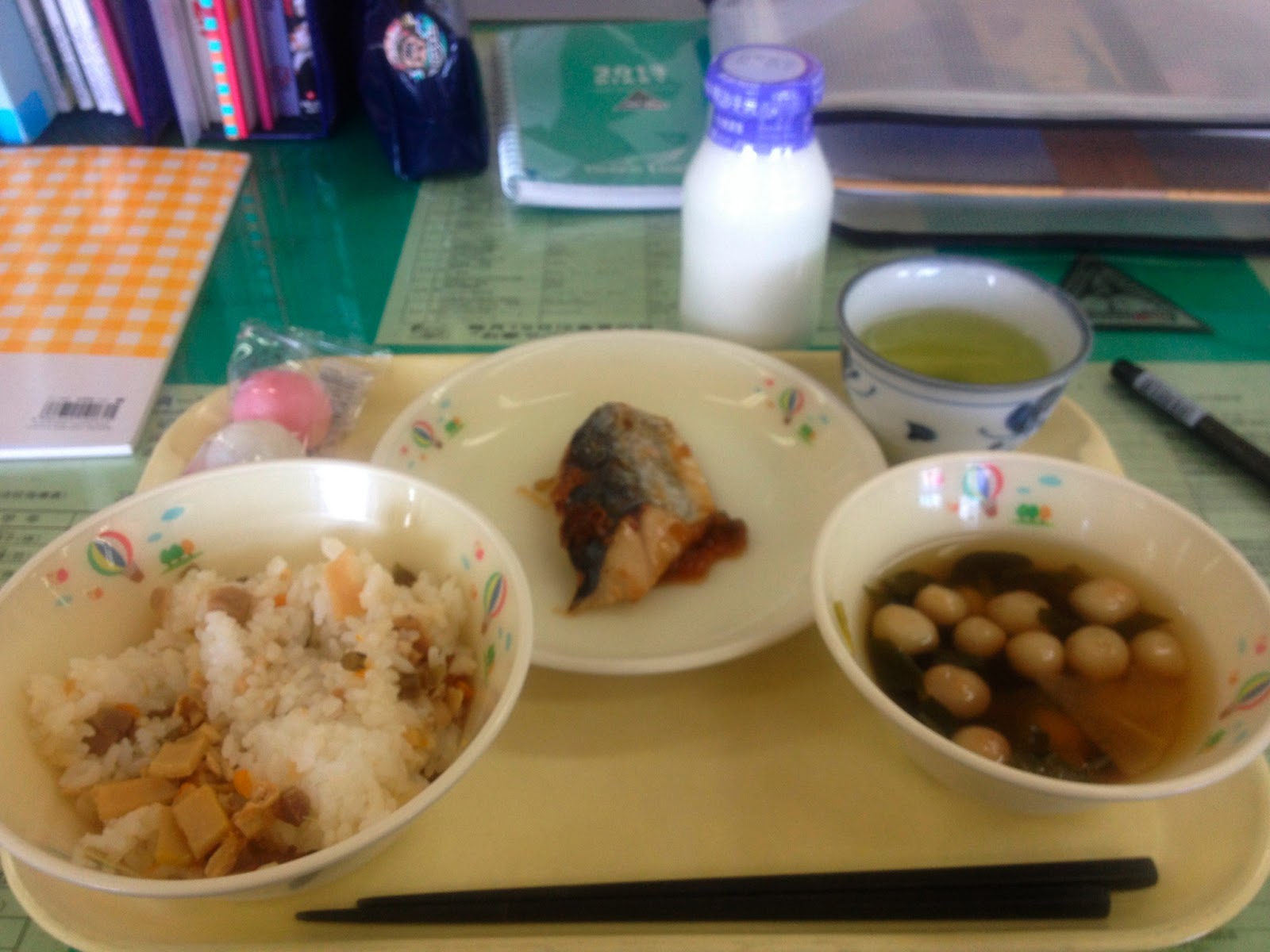
 Soup with fu (a type of rice gluten), takinomi gohan (rice with bamboo shoots and vegetables, sawara (Spanish mackerel with an onion sauce, hanami dango (skewered sticky rice balls, and milk